From a technical perspective, Il Giro d’Abruzzo 2026 is somewhat unusual compared to other short stage races. This year, in fact, the toughest and most selective stages come right at the beginning, meaning the riders will need to be on high alert from the very first kilometre. The opening stage, from Cupello to Casalincontrada, could already prove decisive.
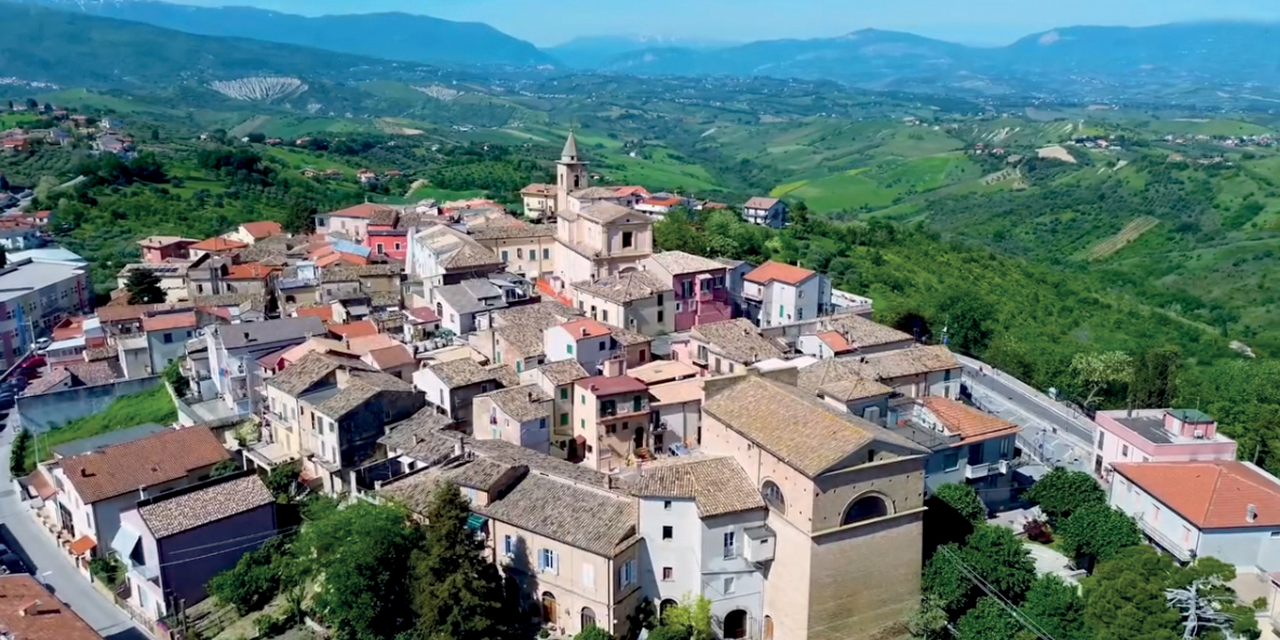
The stage starts in Cupello, making its debut as a host town for a cycling race of this calibre. Set among the rolling hills of the Vastese area, in the province of Chieti, the town lies in a predominantly agricultural landscape stretching towards the Treste and Trigno valleys, dotted with farmland and olive groves. Cupello is best known for its artichoke, also known as “Mazzaferrata” because of its distinctive shape: a local thornless variety with a tender, fleshy texture, harvested mainly between late March and April. Traditionally, it is stuffed with cheese and eggs, while the smaller artichoke heads are often preserved in oil. Among the town’s main landmarks are the Church of the Nativity of the Blessed Virgin Mary and Palazzo Marchione. Cupello’s strong ties to agriculture are celebrated every spring with the Artichoke Festival, first held in the late 1960s and now firmly established as part of the town’s identity.
From there, the race heads towards the coast and the Sangro Valley, tackling a relentless succession of climbs and descents through Bomba and Villa Santa Maria before the ascent to Montelapiano (8.8 km at 6.2%). After Casalanguida comes the Colle dei Ferrari, whose descent leads into the final 35 km of the stage. Beyond Guardiagrele, the finale promises plenty of action, with a 2.4 km climb averaging 7.7% up to Casalincontrada. With several sections exceeding 10%, this is where the decisive moves could be made.
A stage between Cupello to Casalincontrada
Casalincontrada also hosted a stage finish at the 2017 Giro d’Italia U23, with victory going to Francesco Romano. Set among the hills of the Chieti area, with views stretching towards the Majella, the town has a compact historic centre built around the ancient Porta da Capo. Dating back to the 14th century, this pointed brick arch is topped by a 15th-century stone sculpture of the Madonna and Child. The area’s most distinctive feature, however, is its traditional raw-earth houses, built using the so-called “massone” technique—a mixture of earth, water and straw deeply rooted in Abruzzo’s rural heritage.